
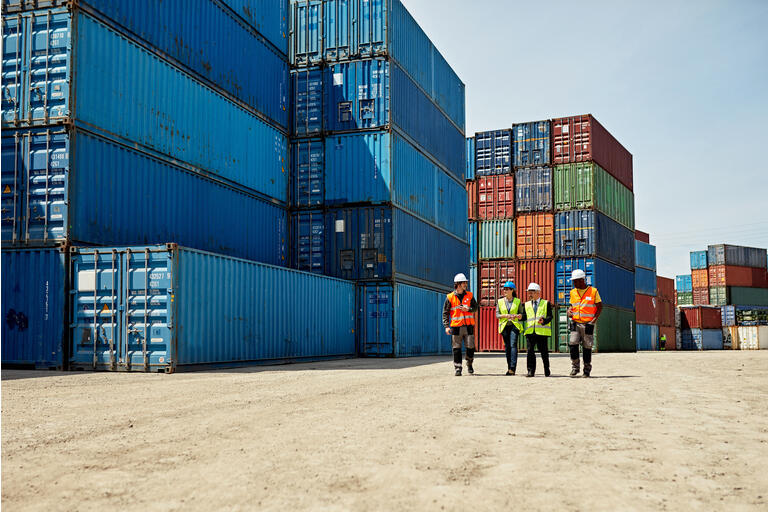
xavierarnau/E+ via Getty Images
Listen and subscribe to the Marketplace Roundtable on these podcast platforms:
I featured TGH in a recent public article as one of my top picks for 2022 due to the strong market conditions, excellent contract growth, and dedication to increased shareholder returns.
The Textainer Group (TGH) management team joined Value Investor’s Edge Live on January 10, 2022, to discuss the container box leasing markets and prospects for 2022. TGH spent most of the past 18-months prioritizing growth capex, but they have also been actively repurchasing shares, and they re-launched their dividend last quarter. As we shift into 2022, higher shareholder returns appear likely as growth capex will eventually slow down. TGH has signed most of their recent growth on 12-year to 14-year contracts, so once the forward growth slows, TGH will have enormous resources available to either pay large dividends or repurchase more shares.
This interview and discussion of the underlying LNG global markets is relevant for anyone with container shipping interests or investments, including firms such as Atlas Corp (ATCO), Costamare (CMRE), Danaos Corp (DAC), Euroseas (ESEA), Global Ship Lease (GSL), Matson (MATX), Navios Partners (NMM), Triton Intl (TRTN), and Zim Integrated Shipping (ZIM).
Topics Covered
- (2:00) How are box leasing prospects shaping up for 2022?
- (4:45) Is capex slowing in 2022, or might volumes be similar to last year?
- (6:45) Current economics in growth projects? Still near record levels?
- (9:00) When will free cash flow shift towards higher shareholder returns?
- (11:00) Balance sheet update? Still targeting 75-80% leverage?
- (16:00) Preferred equity discussion- potential for more?
- (17:30) When will lower legacy contracts roll to new deals at higher rates?
- (21:00) Penalty rate on old contracts vs. current market rates?
- (26:00) Potential for dividend raises going forward?
- (29:30) Timeline for shifting into heavier shareholder returns?
- (33:30) How should investors value a business like Textainer Group?
- (37:00) What else can TGH do to close the massive stock valuation gap?
- (38:30) What are the key risks and concerns for 2022 and beyond?
- (42:30) Counterparty risk and contract strength/structure?
- (48:45) What is the risk if we have huge inflation in the coming years?
- (51:45) Why should investors choose TGH as an investment vs. peers?
Full Transcript
J Mintzmyer: Good morning everyone. Welcome to another iteration of Value Investors Edge live, recording at 10 am Eastern Time on January 10, 2022. We’re kicking off our January 2022 Shipping Forum Series here on Value Investors Edge. We’re starting off with Textainer Group (TGH), which is a box lessor company focused in the container ship side of the business. We’re hosting their CEO, Olivier Ghesquiere, as well as their CFO, Michael Chan. Good morning, gentlemen. Thanks for joining us.
Olivier Ghesquiere: Morning, everybody. Morning, J.
Michael Chan: Good morning, J. Good morning everyone.
JM: As a reminder, nothing on the call today constitutes official investment advice or company guidance from Textainer Group. I have a long position in TGH, as well as peer Triton International (TRTN).
Yes, it’s great to have you back on our platform. I know we talked a little bit last fall. The box lessor sector is an interesting segment of the container business. It’s often overlooked by investors who are usually focusing either on the liner companies, or they’re focusing on the ship owners, the ship lessors. So you guys do the boxes, the 20 footer, 40 footers, the refrigerator stuff, everything like that.
I want to just open up kind of with a broad question and ask about how their prospects are shaping up for 2022. Most of us are already familiar with ’21. The contracts were really the best we’ve ever seen. You were enjoying a lot of lucrative roles on some of your historical deals. How are things looking at 2022? Are we maintaining that momentum, are things slowing down a little bit? What do you see from your end?
OG: Well, J, it has indeed been an absolutely incredible year in 2021, as you just mentioned, and 2022, so far looks like it’s going to be another very nice year. I think there will be obvious differences. The main one will be the growth, I mean, containers are absolutely essential to move cargo around the world. And with this COVID economy that we moved in, we really saw a surge in demand for goods and that created some congestion. And the net result was that 2021, saw a total production of 6.5 million TEU, which is much higher than the long-term average for next year, or this year, shall I say. 2022, we see probably a more reasonable number in terms of production level coming back to a long-term trend between 2.5 million to 3 million TEU. But that means that there still will be growth opportunities there.
Most important, we see a continuation of much of the congestion around the world. We don’t see that being alleviated anytime soon. And as experience shows, congestion is generally beneficial to container lessors, because that is where we provide our added value service. That’s where we have inventory readily available when shipping lines need them because they haven’t been able to reposition their containers. So all of that, combined with continued government incentives and continued consumer demand are pretty good signs for us. And we certainly expect a very solid year in 2022, as well.
JM: Yes, 2021 was outstanding. We saw these leasing terms anywhere from 10 to like 14 years on rates that we’d really — at least I’d never seen before. I don’t know if there was anything you’d had seen before in previous years or not. But there was a constant — there’s steady growth as well and it wasn’t just the terms were getting better, the volumes of containers ordering were accelerating.
It accelerated a lot into quarter one and quarter two, and then it seemed to slow. When you reported Q3 the volumes came down a little bit. Are we still kind of seeing that trend, CapEx going down for Q4 and into ’22, or are we picking back up on volumes? I know you can’t speak specifics, because you haven’t reported your quarter yet, but just broadly speaking.
OG: Yes, just broadly speaking, it’s fair to say that, we essentially saw that the second half of 2020, and the first half of ’21, with the extraordinary high volumes. And then CapEx did moderate a little bit in the second half of last year. We’re pretty much online with what we have seen over the last six months, meaning slightly slower growth, but still continued growth and continued demand for containers.
I think the most important thing for us that happened last year, is really that shift from our usual contract maturities that used to be in the region of five to seven years on new leases. And that has really been extended to much, much longer duration. On average, last year, it was more than 12 years. We certainly see no change there. We continue to see very, very long-term maturities. And that essentially means that those containers will be on lease for their entire economic life.
And it also means that pretty much the risk associated with the cyclicality that container lessors used to be affected, is going to disappear. That essentially really means that those cash flows will be generated steadily for the foreseeable future. And that certainly is probably the most positive sign that we’ve seen over the recent months and quarters.
JM: Yes, it’s very good to see those terms, but understanding the volume just slowing down a little bit. Last year, we talked, and I know every company, yourself and your peer Triton use a slightly different metrics to talk about their economics. But before last year, we talked about the unlevered return, and that was just kind of cash-on-cash. And you talked about achieving 10% plus unlevered returns, or I think you said cash-on-cash returns on these 12-year contracts. Are those economics — is that still viable, going into ’22? Are those economics dialing back a little bit?
OG: No, that’s pretty much still what we observe. And I would say that our position with regards to the market is very much that we are willing to continue to invest as long as we can achieve those returns. But if for whatever reasons, competition were to intensify and we saw lower yields in the market, we would be very happy to take a step back and wait for market conditions to turn more favorable again. But I don’t think we’re at that stage yet. I mean, we are still seeing very, very positive yields and cash-on-cash returns on new leases that we have been closing.
As you rightly pointed out, it’s probably the overall volume of deal that has kind of tapered a little bit. And it could not be any other way, because last year was absolutely phenomenal. It is only normal that we are seeing less or a little bit less pick up from shipping lines. They pretty much all have enough containers in their fleet at this point in time.
Whatever additional quantity they take is really to alleviate the temporary shortage due to the congestion. But it’s also, as I mentioned, a fact that after such a strong year of 2021, where total production reached 6.5 million TEU, we are fully expecting that level of production to come back down to probably half that level.
And again, that’s one of the great positive sign of our industries that the manufacturing lead time for new container is fairly short. It’s anywhere between two to three months on average, which means that supply and demand can adjust very, very quickly. And that’s another very strong sign.
JM: Yes, it certainly makes sense. I mean, we as investors and someone who’s becoming more familiar with the company, I was very excited about those economics last year. But I also know that investors want to see shareholder returns, whether or not that’s a dividend — you launched a dividend last year — whether or not that’s more repurchases. But there’s only so much free cash flow, and you have to allocate it either to growth, to CapEx, or you have to allocate it to repurchases, which is sort of like per share growth, right, or you can allocate it to dividends.
And right now, the growth has been so attractive and so lucrative that that’s been the primary funnel, right, of your extra resources. But if that growth slows down, it sounds like there’s going to be more room for repurchases and dividends and stuff like that. Is that fair to say?
OG: Yes, that’s absolutely fair to say that, the nature of our business is that we do generate a tremendous amount of cash flow, especially with the recent CapEx that we have deployed over the last 18 months. We’re expecting to generate very steady cash flows over the foreseeable future. And I’m not talking only five years here, I’m talking pretty much 10 years. And it’s a fact that if we are going to see a reduction in in CapEx, we are going to generate more cash flow that will not be used towards buying new containers. Obviously, buying new containers is always going to be our priority because that’s what guarantees the future cash flows.
But if we were to see a lower level of investment, we definitely have a lot of cash flow available, which we can then allocate between dividends or buybacks with the main benefit of buyback being a lot more flexible and a lot more opportunistic in terms of what we may decide to do.
JM: Yes, of course, it makes sense. And your balance sheet is in a much better position today, as well than it was, in a year from now. I do want to talk a little bit about the balance sheet too, before we — because I guess there’s a lot of questions to ask about the dividend and repurchases. But just to kind of cover the basis here, are you still targeting that same 75% 80% leverage on those newbuilds? Is there any sort of plan to shift that debt structure? Because I know you were redeeming some of your old debt that had more covenants and things like that? Can you walk us through that a little bit where the current balance sheet goals are and how that transformation is going to look like in 2022?
MC: Yes, J, our balance sheet is in pretty good shape and as you know us, we love using leverage to fund our CapEx. So our advanced rate against our assets are around that 75% to 80% leverage rate advance rate. That’s a pretty level going forward, we wouldn’t mind pushing up further, of course, given the terms of our debt right now that they’re so attractive, and we’re able to fix a lot of interest rates on this data substantially so that it matches well with our longer lease tenders, which are fixed as well.
So I think that’s a good target to use. We love the pricing, we like the levels very easy to manage, as well. And the terms underpinning this debt are attractive to us, too, and very flexible to us and perfect for our business. We’re always looking out for other ways to fund our assets or new options to do so. And the idea there is to expand the diversity of our sources. Always good to have variety pools of capital to draw from to fund our CapEx. In case one market is more attractive than another, we just shift from one market to the other, to tap that cash in order to buy the boxes.
There’s some new sources that we’re about there, new source of capital. I know that one of our peers has gone towards investment grade unsecured debt, we’re evaluating that as well. Having said that, our approach right now using fixed rate long-term AVS funding for CapEx is big attractive and also competitive as well. It seems consistent, we’re getting the tenors that we want. So we love that.
But again, we are looking at other ways to expand the diverse for resources. It’s always smart to do that and we are looking into that, of course.
JM: Of course, Michael, thank you. One of the push backs or I guess skepticisms that I see a lot from folks, when I say hey, look at this, Textainer Group company is oh, wow, they have a lot of leverage, right? There’s too much debt on the balance sheet. And a lot of companies in the shipping space have spent the last year rapidly delivering, paying back to at every chance they can get, but it seems like with your structure with your contracts, leverage is actually very attractive, it actually makes sense to have more leverage.
But I imagine the banks, I mean, they’re not dumb, they’re looking at these contracts, and they’re making sure that the loan facilities are aligned. Can you talk about that a little bit, kind of the amortization schedule, and how that aligns with your contracts?
MC: Yes, the amort schedule, it’s actually what we did during the last couple of years J, is we tried to better match the schedules and our long-term debt. So if you look at our leases, it’s best to start with that as the length of the tenors have been expanding. And right now, if you look at the fixed rate average tenors of our whole lease portfolio, it’s about six years fixed, cash flow is ongoing, which has grown versus, say about three to four years in the past. So this is a significant improvement, improves the stability of cash flows ongoing.
In terms of matching the amortization or debt against that, that’s critical. What we’re doing there is when we match our debt against these leases, a couple things we’re doing, we’re fixing the rates, interest rates with this debt to trying to match the tenors or debt, so that we lock in that interest rate profit margin, meaning the margin between our fixed revenues and that of our finance costs, which are fixed as well largely at about 6.6 year average to see, if you see 6.6 years of fixed rate, long-term debt matches well with our six years of lease fixed, lease stream too.
The amortization also, we tinker with as well, when we’re looking at the tenors of our debt or in terms of our debt, we modified them whereby they’re very flexible. And the amortization also matches well with the amortization of our depreciation of our assets, so, it stays in line with that. Where the debt rolls down as our assets roll down through with the depreciation. So it matches very well.
Also modify the amortization then, so that it is perhaps a little bit more shallow and better match with the depreciation rate where we don’t overpay back that principal. So it’s right amount where my really stays in parody with the depreciation of assets. And that makes for a more efficient, I guess I’ll call efficient use of our leverage against the assets.
JM: Yes, no, that’s certainly makes sense. I mean, that is aligned with the fixed contract payments, like this is a speculative debt, and some of the some of the peers, ship owners and such like that sometimes they do new build orders or something and they take debt. And it’s all speculative. This debt is actually backed by cash flow, so as much different.
Last year, you had two preferred equity issuances. In fact, the second one, I couldn’t even believe I mean, the interest rate was so good, it was 6.25%, I believe. And I never seen, there’s only one issuance I saw lower than that and that was actually one of your peers. But at 625 basis points, I mean, is there any potential to do more of that in ’22? I mean, I’m just looking at this for fair at 6.25. And I’m looking at your common equity with an ROE of over 20% with a free cash flow yield of somewhere in that 20% range. And I’m just seeing this huge gap, I mean, it’s impossible to do more of that?
MC: We certainly love our preferred share issuances. They have an important position within our capital sourcing structure. Unfortunately, we can’t really speak to that for 2022. But know that we do like that prep structure, it’s very important to what we’re doing here has a very good purpose as soon as webinars back. At some point in the future, we may shoot another but we unfortunately we can’t go into specifics, of course.
JM: Yes, I don’t want to put you in an awkward spot. I imagine there’s always discussions are ongoing in the background. But if you can get a TGHC series out there, then a big fan of that one, maybe arbitrage between the common equity at 20% plus and the preferred at six point. I mean, it’s just it’s an enormous arbitrage potential there.
One of the issues we’ve had Michael the last year, and I don’t know if Olivier wants to jump on this one as well. You had a lot of legacy contracts, and they were not advantageous contracts, they stemmed I think from 2014 and 2015, when the market was really bad when Hanjin was going bankrupt. And we’ve been looking forward to rolling those, old legacy contracts on the newer rates.
But the way I understand it is a lot of those have sticky provisions, or they have kind of an optional hand back period and stuff like that. When can we expect to start seeing those contract rolls flowing through? Is that something that can happen in 22? Or is that something that’s going to take a little bit longer for those old legacy contracts to start getting renewed?
OG: No, J thank you for raising that point. Actually, we have already started to see the benefit of it, we have already renewed some leases at higher rate. It’s a process that does take time because of the nature of the contracts and the fact that most clients have a provision in the contract that allow them to sort of build down the fleet and during the build down, they continue to enjoy the same contractual rate that they historically had.
Now, this said, we’re in an environment where typically leasing rates are moving in proportion to new build prices, and new build prices are today about twice the level of the OEC for those older containers that we have in our fleet under those long-term contracts that are maturing. That essentially means that whenever one of those contracts reaches maturity, it is at a certain rate, whereas the market rate for a new container is about double. And that puts us in a very strong position to renew some of those containers. Obviously, most of our shipping line customer will tend to try and drag their feet a little bit and only renew those leases when we reached the end of the build down period.
But as we are moving in time we are getting closer to a few of those contracts reaching maturity and as I was starting to mention, we’ve already renewed some with positive increases and positive terms. We always have to keep in mind that for us, securing the cash flow is also extremely important. So it’s always kind of a negotiation between ensuring that we can extend the leases on a long-term contract so that those cash flows are secured and at the same time try to achieve some element of price increase.
But we’re at that level where we have done a few of those renewals, and we certainly expect to have some more in in 2022, and 2023. These will be the important years in regards to those legacy leases as we call them internally.
JM: Yes, thanks, Olivier. And then we had a question from a member of our group and I think it’s a really good one, it’s delving into this a little bit more. Talking about I guess you would say the option value, right? Because the way I understand it is your customers have like a delivery window, it’s basically a year, right. And if they don’t deliver within that timeframe, there’s a penalty rate.
But my understanding is, I mean, the penalty rate is higher than what they’ve been paying. But the penalty rate rates are so phenomenal today that the penalty rate is actually smaller than the market rate. So can you talk about that a little bit? I mean, like, how much of a gap is there between this penalty rate, or this optional handbag period versus the actual market? My understanding is, there’s pretty big gap. But can you elaborate a little bit on that?
OG: Yes, no two contracts are identical, so it’s pretty much a little bit of a jungle out there. But I would say, typically, a post builds down rate is 50% above the base rate, which is, I think, quite a significant increase already. And if you just take the average lease rate of our fleet before all these new containers that were put into service will probably a little bit below $0.50 per day. If you assume that a 50% increase on that would bring you to maybe $0.75 per day on a container, you’re pretty much there in terms of the market level for a depo container, or a use container that is seven to eight years old, which then compares to the price of a new container, which will be a little bit above $1 a day, maybe $1.10, or something like that.
So it is a significant increase, I wouldn’t say that it’s minimal. And it’s kind of comparable to what the market would be. But as I started by mentioning, no two contracts are identical, there are all kinds of different clauses, there are certain customers that would then prefer to return containers. And we’re also in a great position there, because the resale market is so strong at the moment that even when we get a container that is nine or 10 years old, we can sell it at a substantial profit.
And what we usually do is we do a simple NPV analysis as to how much we can generate by selling that container straight away, or if we can lease it out on a long-term lease again. And the choice recently has been to sell quite a few containers, and that has been visible in our Q2 and Q3 results and that also coming into play. And I just wanted to emphasize that because that puts us in a very favorable position. If we have a customer that refuses to renew leases, under terms that we deem reasonable, we’re happy to take those containers back and sell them on the second-hand market straightaway.
JM: Yes, certainly makes sense. I mean, you have a lot of options right now. It sounds like the penalty period, you said it’s 50% above the base rate, which obviously means strong year-over-year growth for you. But if it was double the market it was double the legacy contract, then you’re kind of splitting the difference as it were. So, it would make sense where some of your customers might want to just pay the penalty rate for a little bit and kind of benefit from that. I mean, it’s still helping you out, but it would be nicer obviously, if you could get the full market rate.
Related question about provisions. Is there anything in these longer term contracts? The new ones, the ones that you’re signing for 10, 12, 14 years? Is there anything in there about inflation or those just fixed rate steady for the entire period?
OG: No, typically in the industry, there’s no provision for inflation, these are fixed rates. But what is important is that these are leases concluded for the remaining economic life of the assets. And even though those leases will maybe mature when the assets are say 15 years of age, we still have a dead end, meaning that the customers either have to return those containers to us, or will again have to pay a post bill down rate. So there’s such a provision in most of the leases we mentioned.
And, J, if you allow me just to come back a little bit on what you said or earlier, again, this is a very difficult topic. And we’re trying to model the price increase is something that’s extremely difficult even for ourselves. Because in those negotiation we always end up with some kind of trade off.
Typically, customers don’t like to end up having to be forced to pay a post build down rates, in some cases, and usually, we end up with a negotiation where we agree on something. But there’s always other elements that come into play that we can kind of leverage our position to combine an extension with additional new containers being leased out, or some other tradeoffs that can take place in those situations.
JM: Yes, I suppose we’ll just look quarter to quarter to quarter, you’re going to be reporting your Q4 ’21 here in a month or so and we’ll just continue to see how that progresses, hoping obviously for continual increases. That’s what we saw all last year. That’s what I’ve personally modeled, but we’ll see how it comes through and I have full confidence you’ll be able to deliver there.
I do want to pivot a little bit. I mean, I think we’ve covered the contracts pretty well. I think we’ve talked a lot about kind of the balance sheet. Now I want to talk a little bit about shareholder returns, repurchases, dividends and how those factored in. You launched a dividend last year, it was your first dividend in five years. And it was $0.25 per quarter, which at, face value is a decent dividend for this market. Right? It was $1 a share it was a 2.5% 3% yield. But compared to your free cash flow, I mean, it’s a tiny fraction. Can we talk about that dividend a little bit? Is there potential to raise that going forward? Is that just a starting point? How do you think about that dividend?
OG: Yes, sure. I think the important element here is being for us really to reinstate the dividend, I think it was an opportunity for Textainer to kind of turn the page on that the Hanjin situation, which was very unfortunate, and there was like a perfect storm against the strategy that was then in place for Textainer.
We have always said that that was our main objective, that we felt that the business was ideally suited to paying a dividend. And our ability and the announcement that we were resuming paying a dividend, even though essentially this wave of high CapEx level was still in process, I think was something very positive.
Now, the way the Board did set the dividend, yes, they could have set it at a higher level. But I think that the consideration was A, reinstate the dividend, B, make sure that that dividend is absolutely sustainable, no matter what happens if we have to face additional CapEx, or if we face a downturn in the future, that we are absolutely certain that we can maintain that dividend. And essentially, you alluded to it put ourselves in a position where over time as the profitability of the business continues to improve, we can look at improving that dividend yield.
I think that the other big, big element in the decision was that, paying a dividend is certainly something that we absolutely wanted to do. But we also and the Board also wanted to retain that element of flexibility, in terms of looking at the options we may have to do more buybacks if we were to have a lower level of CapEx going forward.
JM: Yes, certainly makes sense. There’s a lot of tradeoffs. And I know, you see the dividend as sort of the fixed component of the business, it’s always going to be there, you want to raise it, never have to reduce it again. And buybacks are more discretionary, depending on how much free cash flow you have.
I know, I’ve talked with Michael before in the past, and we talked about efficiently allocating free cash flow, and there’s really three options, you can invest more in the business, via CapEx, you can do repurchases, or you can do some sort of dividend increase. And it seems like, based on the economics that we’ve talked about, the most efficient smartest thing to do with cash is to invest almost 100% exclusively in CapEx, because the returns are so phenomenal.
But the problem is, at least from an investor perspective, is the market either doesn’t understand that. The market just ignorant to the kind of economics you have here, or the market, just really skeptical and negative and the market wants to see immediate repurchases, dividends, stuff like that, the market is extremely discounting the out years. I mean, if you look at year two, three, four, all the way out to 12 or 13. I mean, the markets got you valued at like an NPV 20, I mean it’s pretty phenomenal. So, that’s why I asked the question, because I know a lot of investors are kind of hoping that you’ll shift from — I mean, last year, you were like 95 CapEx, 5% returns, and I think the markets kind of hoping that eventually you’ll shift more into like 50-50. Is there a trajectory or a timeline where we’ll go from more of like, 95-5, to like 50-50 in terms of growth and returns?
OG: Yes. Listen, the way I’d like to answer this question is, is this way. I think a lot of investor still wrongly perceive container lessors like ourselves, as a cyclical business that is too closely related to the cycle in the shipping industry. The reality is that, with all those very long-term contracts that we have been able to put in place, or business is still related to the shipping industry, but is going to be a lot more stable than it has ever been in the past. And therefore, we kind of fall back on this negative perception that Textainer may have peeked and Textainer is kind of a short term value.
When in reality, the only way we can manage this business is to look at the very long-term. And our experience has also shown that this this fundamental aspect that when the hay is right, we have to harvest it, and we’re exactly in that situation. Right now, where we’ve got phenomenal opportunities to deploy capital on long-term contracts, attractive yield, which we can finance at very low rates. And this is what is going to form the basis of all the cash flows that we’re going to generate over the future 10-12-13 years. And certainly, we don’t want to miss on that opportunity.
Inversely, if we don’t see those opportunity, and if the yields were to drop suddenly, we would be very, very happy to take a step back. And this is what I really would like to underline in terms of our philosophy and our approach in terms of managing this business long-term. It’s really all about timing and making sure that when the opportunities there, we do what is best for investors in terms of long-term value creation. And when the market is not there, we can look at other way of returning capital to investors.
And I do realize that in some, for some of our investors, they may perceive this as a little bit to longer term compared to their view. But we’re absolutely convinced that this is the right thing to do for our business, when we compare ourselves, for example, to other similar segments, such as the GATX, for example, they are trading at 30 times PE and they have a business that is probably a little bit more stable than container lessors.
But certainly doesn’t have the same growth opportunities that we continue to see and continue to have. And we believe that very much showing that stability and that long-term profile is also going to help us in terms of read rate the business and bring it back to probably not 30 times PE, but certainly to a level which should be in line with our long-term multiples, which are between 10 and 15 times PE.
JM: Yes, thanks, Olivier. That’s actually a great segue. The next question I was hoping to ask is, how do you value a company like this? Because a lot of investors are looking at you and you’re saying, well, do I use price of earnings, do I use — I think some folks might accidentally use dividend yield and say, and that, of course, would be a shame because your dividends a tiny payout of your free cash. But what sort of metrics do you look at, you mentioned price earnings already? Is there anything else you look at, do you look like NPV of cash flows, do you look at like free cash flow yield multiple, what sort of stuff do you look at internally when you’re comparing your company to peers?
OG: Yes, we obviously look at PE and I mentioned that a little bit, but fundamentally, we really see ourselves as a cash generating business and all our discussion today show we really are a cash business, it’s all about, essentially buying those containers as efficiently as possible, financing them as efficiently as possible and leasing them at the best term over the longest possible duration.
So it’s really all about cash flow generation. And we have our eyes completely focus on cash generation. That’s why I was mentioning that sometimes rather than extended lease, we rather sell a container because we just make the net present value calculation that it makes more sense to sell the containers.
But I’m sure a lot of investors have looked at our investor presentation and they will have seen that, on slide 10, we’ve attempted to try to show the sort of like run off of the existing fleet under assumptions that we think are very, very conservative, where we show essentially, all the revenue that is already locked in, then we just assume that we’re renewing our existing leases at the same rate they’re currently are on which as I explained with the current price of new container really should not be a problem, they should definitely be higher than that.
And we’ve also assume that, we’ve continued to sell containers at their residual gap, residual values. When in reality, we’ve achieved consistently gain on sales and profit on disposal of those all the containers. And when we just do that without taking into consideration the element of time, we get to a cash generation of $10 billion, which I think shows that the gap there is between the amount of cash that we will be generating, the debt we have, which is a little bit below $5 billion, and then or stock valuation, and these are very high level numbers, because I don’t think it’s really our job here to go into the detail of an NPV analysis. But certainly, if you just look at the high level numbers, I think any investors would come to the conclusion that our current valuation is probably very much on the extreme low side.
JM: Yes, it’s pretty remarkable. I’ve ran some numbers myself and of course, there’s lots of assumptions that go into some of those numbers. But I ended up with an NPV of nearly 20% and that’s pretty phenomenal to see something like that, you’d expect to see 8% 9% 10% for a business like you have, and yet it’s basically double that. So, I mean, that implies that, if you traded at that sort of NPV of 8%, 9%, 10%, your stock would more than double, obviously, it doesn’t trade there yet.
What else can you do to close that gap? I mean, you’re doing the right thing, you’re investing in the core business, you’re growing that platform, you’re doing a few repurchases. Is there anything else you can do to try to close that valuation gap?
OG: Well, I think optimal capital allocation is going to be very important between CapEx and buybacks to put it simply. But more importantly, in our view, and our fallback here on the long-term strategy of the businesses, I think, to continue to show that consistently we’re delivering a stable return, stable growth in the foreseeable future, and that we are no longer subject to some element of cyclicality as we may have been in the past, and that essentially Textainer has turned the page that the business has completely turned around. And it’s really on a strong foundation to continue to grow going forward. And I believe that time allowing, we will demonstrate that Textainer is going to continue to deliver very, very good performance over the coming years.
JM: We certainly hope, so I do think at this point in the call we do need to talk about the risks or concerns or anything that could potentially slow down or derail this story in 2022 and not just this year, but going forward over the next decade, because you just mentioned a slide that shows your cash flows all the way out into the 2030s. What are the key risks or concerns here both for yourself as management? What are you looking at? And both for you like investors, what should investors look at and be concerned about?
OG: Well, I would make a difference between the kind of short to medium term risks and the longer term risks. I would say, if we look at the short and medium term, as I mentioned, we see a continuation of the COVID situation. We probably have a risk of COVID, not being contained away, the Chinese government we want to contain it in China that could disturb production of goods in China, it could also disturb production of new containers in China.
But again, as history demonstrate any kind of disturbance to the market has always benefited container lessors, because we are then in that position to be able to provide containers and provide that flexibility when shipping lines needed. So we feel that if that were to happen, it would probably be another additional benefit to ourselves.
One risk, which was traditionally also affecting container lessor was the counterparty risk with the shipping world being very competitive, and some shipping lines always on the verge of default, and unfortunately with Hanjin defaulting, as we have experienced very harshly ourselves. But, the shipping lines have now made more money in a year and a half than they probably have over the last four years, they’ve used all that cash to pay down debt and rebuild their balance sheet. So I would say that for the coming three to five years that risk is probably extremely remote.
Then looking at 2023 2024, we have shipping lines, getting delivery of additional ships, that’s a high level, they have ordered a lot of container as soon as they started generating higher profits, but we actually see that as an opportunity again, because 2023, when the new ship starts coming in, it will require more containers, and they will obviously have to source some of those containers from container lessor. So that is also coming in line with the 5% growth in containerized trade that we have seen over the past 15 years, and we think we’ll continue to see over the coming five to 10 years going forward.
So, we are not really concerned about too many ships coming for delivery, we see that as an opportunity. Probably the biggest risk we may face, is a political risk, an incident in the Taiwan Strait or Taiwan Strait or something like that, that would definitely be a very negative impact for world trade and for container trade, in particular.
But in terms of the fundamental, I think that we continue to see steady growth, we continue to see potentially cargo moving away from China, and probably not being onshore, but certainly cargo being sought from new destination, more coming from Vietnam, Thailand, India, Brazil, and places like that. And all those places, most of them are actually even a little bit further away from their markets than China, which means that, the round trip for containers is going to be longer. And that is going to generate more demand for containers going forward. So we remain certainly pretty bullish looking at the future.
JM: Yes. Thanks, Olivier. I appreciate that. That’s a good breakdown of the factors to consider and some of the potential risks out there. I think the risk that most investors I’ve spoken with think about right away is counterparty risk. And of course, as you mentioned, counterparty risk for ’22 to ’23, probably ’24, I mean, it’s basically nil. I mean, these companies are drowning in cash, billions of free cash on hand, most of them are being conservative with their cash. They’re kind of hoarding it, if anything.
But counterparty risk could be a factor, maybe in the out years, right, ’25, ’26, ’27, ’28, all the way to 2030, whatever. Can you talk a little bit about, folks who aren’t familiar? Can you talk a little bit about the structure and strength of these contracts? Like how easy or difficult is it for a company in financial distress to get out of one of these leases?
OG: Well, those leases are firm contracts. So, unless there is a bankruptcy and there’s kind of an agreement in between all the creditors, shipping lines essentially can’t get out of those contracts, these are really firm contracts. I think, another very important element to understand is that even though new container prices have gone up tremendously throughout this cycle, we have not modified or residual value or depreciating value.
So we’re still depreciating the container down to the same residual value at essentially what is a very accelerated depreciation rate. Which means that, if you look out in seven years from now, a big portion of that additional costs in those containers will have been absorbed through depreciation and we would have assets on our balance sheet that are going to be certainly well priced and priced according to depreciation schedule that is very aggressive.
And to us, one of the big question going forward is going to be to see whether a new container prices remain elevated in which case we probably would see in the future, a residual value coming up in line with new container prices that would not be illogical, either.
JM: Yes, it makes sense. And I’ve followed, not your company specifically, but I have followed the industry for more than a decade. And one thing that I saw last time back in 2010, ’11, ’12, when we had financial difficulties, we had PIL we had — ZIM had financial difficulties back then, HMM later on, in all three of those cases, and I think there was a few other smaller ones. The box lessors were kind of untouched or very friendly in that negotiation, because that’s an operating structure of the business. They didn’t want to lose their containers, they wanted – their business was still continuing, even if a financial structure was shaky.
I think Hanjin was one of the very few cases where the actual company itself went completely bankrupt, shuttered, closed the lights off, like Hanjin no longer existed. And that was a case, where there was some bumpiness, and you had to sign new contracts and stuff like that. But my understanding is, is that was kind of isolated and other than that all the contracts have held solid. Is that a fair assessment?
OG: No, that’s a very fair assessment, I mean, containers are absolutely essential to shipping lines to be able to continue to operate. And if there’s one supplier that shipping line would not want to alleviate is definitely container lessors, because they know that they’re always going to need containers, if they don’t have containers, they can’t operate. And most of the time, those shipping lines when they hit trouble of orders, they are short of cash and are unable to buy containers. So they only have one option, which is to lease those containers.
And therefore, they’ll make sure that, they try to treat the container lessors worse as fairly as possible. And as you mentioned rightly, the only serious incident where shipping lines would have no choice to essentially stop paying their rental on containers is when the whole company is simply short of cash and about to go broadcast. What the case with Hanjin?
JM: Yes, Hanjin was basically the biggest bankruptcy we’d ever seen in the industry. And it was kind of unprecedented, because HMM got financial assistance, Yang Ming was reported to have difficulties, they got financial assistance. And I mean, there is a list of them, right, it was a difficult period in the container markets.
OG: Sure. And I’d like to point out as well that, Hanjin was a great lesson, I think for everybody in the industry, I think that we recovered 96% of all the containers we had on lease with Hanjin. So it involved a lot of work and a lot of hard work trying to recover all those containers. But at the end of the day, 96% is a very, very high percentage. And most of our peers recovered, all of them between 90% and 97%, I would say of the containers that they had on lease with Hanjin.
So even in the case of an open default, like we had with Hanjin, those containers are not completely lost, we have been able to recover the vast majority of them. So I think that’s very important. And I think that, as you mentioned, we’ve also seen at the beginning of COVID, where nobody thought that it would have this impact on shipping overall, we’ve seen governments are ready to help the larger shipping lines like the French government guaranteeing a $1billion dollar euro loan to CMA CGM. We’ve seen, Taiwanese government support to Evergreen, One High and Yang Ming, we’ve seen the HMM support. So, a lot of governments definitely determine to avoid another disaster with bankruptcy similar to the Hanjin case.
JM: Yes, certainly. You want to avoid that disruption to global trade and it was kind of embarrassing, of course, for the government of Korea as well. So anyways, I think we covered that case study well enough. The other risk I wanted to bring up before we conclude, and we thought we kind of touched on it earlier, is the inflation side. And for folks who are nervous, we’re not talking 1% 2%, maybe 3% inflation, but I think for folks who might be nervous, maybe we get a repeat of the 1970s and we get a 10% or 15% type inflation environment for a few years. I’m not saying that’s likely, I’m just saying it, it could be a scenario.
I understand your contracts don’t increase for inflation. How are you exposed? Or like, what have you done to ensure that, you’re comfortable in that scenario, just in case we did have 10% or 15% inflation for a few years?
OG: Well, if you look at it conceptually, inflation is probably good for asset managers and asset lessors, because it depreciates the value of the containers faster. Obviously, if those assets are leased on long-term contracts, you have the benefit that you get a guaranteed return, but you lose the potential to reprice them. But you always have a portion of your fleet that will mature at some point in time and that you will then be able to lease out at higher rate. And that is something that doesn’t scare us at all.
Actually, inflation, we’re kind of in a situation where our lease rate would readjust automatically. As Michael mentioned earlier on, or financing hedges are in line with the maturity of our contracts, so we’re completely covered there. So even if there was inflation, whatever we have to pay to finance those containers, is covered, and is not going to be exposed to increase in rates. And then if inflation kicks in, essentially, what we are going to see, is that, our new leases will be repriced according to the new prevailing terms in the market, and rental rates will go up if interest rates will go up.
But the other element is that, we will probably also see an inflation on our disposal prices, and our gain on sales are likely to increase over time as well. So overall, I think inflation is not really a big concern as far as we’re concerned, we definitely want to make sure we are probably hedge. And I think that’s why Michael insisted so much that our financing is matching the maturity of all leases as closely as possible.
JM: Yes, I think that makes sense. As long as the financing matches the durations, and as long as there’s a healthy percentage that’s been fixed to — excuse me, swapped into fixed rates, because the bank financing is floating, but as long as you swap it and hedge it that way, so you don’t have negative exposure on the interest rate side. It makes sense to me, it makes sense that you would be fine.
I think we’ve had a great call today, Olivier and Michael, thank you for joining us. I just like to give you the opportunity to conclude here. Why should investors? Right? There’s 50 companies in shipping, folks are looking to sector, there’s 10 or 15 companies in container shipping. Why should investors focus on Textainer Group? Why should they choose you for 2022 and beyond?
OG: Yes, no, thank you, J. That’s a great opportunity for me to speak a little bit about that. I think that a lot of investors I mentioned tend to compare us too closely to shipping. Shipping is by nature more and more volatile, I think that they probably have another good year ahead of them. But everybody agrees that at some point in time, that will turn and that’s reflected in the valuation of a lot of ship lessors and shipping lines as well.
I think the big difference is that, with container lessor, we have these very long term maturities, so we’re not exposed to those cycles. And also, I’d like to emphasize that just the position of Textainer, we’re number two in the industry, all our metrics are fully comparable to or larger publicly listed peer.
We have overheads to revenue that are in line or interest financing costs is even slightly below theirs, or tax structure is more efficient, but more fundamentally, our market position is also I would say, very attractive. I mean, we have a small team, we are a lot more agile. And the fact that our market share is also smaller means that we can just focus on whatever deal we want to make, we can focus on the deal that generate the best yield. And we don’t have to take every single deal that is out there in the market.
While at the same time because our market share is a little bit smaller, we can continue to grow the business. So I think that if you look out to the future, Textainer certainly is the company that has a lot of potential going forward.
JM: Yes, thanks, Olivier. I appreciate that round up and Michael, for joining us as well. Appreciate both you gentlemen.
OG: Thank you, everybody.
MC: Thank you, J. Thank you everyone.
JM: This concludes another iteration of Value Investors Edge live. We just hosted Textainer Group, stock symbol TGH. They are focus in the box lessor segment.
As a reminder, nothing on the call today constitutes official investment advice or company guidance from Textainer group. I have a long position in TGH as well as peer trading international TRTN. This was recorded on the morning of January 10, 2020, around 10:00 am Eastern Time. You’re listening to recording at a later date to keep in mind positions and disclosures may have changed.
from WordPress https://ift.tt/3I7APoM
via IFTTT

No comments:
Post a Comment